Proafile v5.0 | Updated: Feb 18, 2010

Portfolio Proas

Pookie

Posted by on 05/16 at 06:26 PM
Back to the Future. A collaboration with Jim Shanahan.


Tepukai are singularly amazing proas from the Santa Cruz Islands that take the usual South Pacific parsimony with building materials to the nth degree. The boats stretch out over the water’s surface like a gigantic water spider, covering the most area with the minimum mass. Tepukai employ slender, submersible wave-piercing hulls, centrally located mass for low pitching moments, and excellent bridge deck clearance - all very M3K (millennium three thousand).

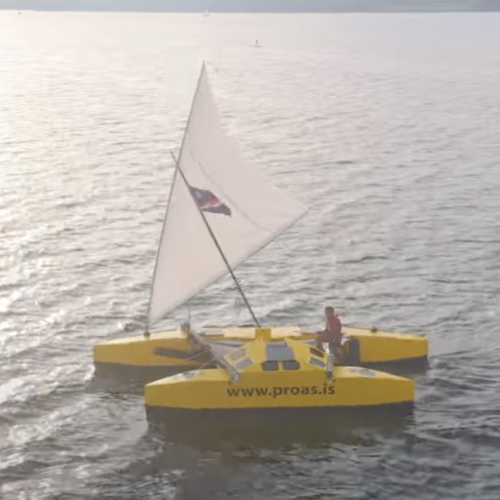
Jim Shanahan approached me with an idea for a tepuke inspired beach cruiser, and Pookie is the result. The boat stretches itself out to a 28’ LOA x 15’ beam, without weighing much more than a Hobie Cat. In the Oceanic tradition, the boat is made mostly of woven materials: Polyester, Nylon, carbon fiber, Kevlar and Spectra.

The basic configuration is a carbon fiber space frame which supports inflatable tube hulls, trampoline deck, shelter and rig. When folded and deflated, the contraption fits inside a 4’ x 8’ x 14’ box - a sailing version of George Jetson’s flying car in a briefcase.


A boat with such an extreme mass/surface area ratio would have a great deal of trouble carrying way through a tack, so the proa configuration makes particular sense in this case, solving the problem by redefining the question.

The rig is a cross between sailboard and crab claw - a pivoting mast allowing the foot to be hauled forward so the CE is centered. The leeway is handled by a pivoting “windboard“ - the opposite of a leeboard. Again, no rudders. Why is that? Maybe because somehow a proa already knows the course.

More about tepukai at Vaka Taumaka and Makahiki.

Comments

  • Looks great, but i am always missing informatins regarding a steering-concept....

    Its the most difficult point regarding proas

    Regards

    John

    Posted by  on  05/17  at  06:25 AM
  • I know! I wish someone would hurry up and invent it! :-)

    Actually, Fulgencio’s twin foil steering comes perilously close to solving the proa steering problem (see comments in Samwise III), I just couldn’t see mounting them to the ends of an inflatable tube. There’s always the steering oar…

    Posted by  on  05/17  at  09:29 AM
  • I have no experience sailing proas but curious about the rig. With clew so low how much sweepback is possible? An illustration of full range of sail’s position would be helpful to determine if the transition to the LEV driven clab claw is possible. The battens may preclude flattening the sail in this position, without battens tension lines in trailing edges on leech and foot could control sail shape maximizing efficiency to balance reduced sail area. Hoping to sail this concept to reality, will post results. Have no idea of self steering qualities of proas but some rig experiments I have posted self trimmed and sailed without a sheet leading to the potential of an extreme design without rudder or sheet.Design looks very clean and elegant.

    Posted by  on  05/17  at  08:05 PM
  • Let me know if you need any help with the design of the twin foil system for this extraordinary boat. It is a great idea. Big, light, portable, cheap?

    Second comment. I believe that unless the mast pivotes, or the sail is hold very high, you can not move the CE substantialy by shunting the heel.

    Third and last.
    An oar is allways convenient, at least to approach the beach in shallow water.

    Regards,

    Fulgencio

    Posted by  on  05/18  at  11:03 AM
  • WOW! Finally someone has attempted a modern proa based on the TEPUKE! Tepuke is my favorite tradition of proa. I believe the ultimate design question in the Proa Sailing Universe is; What is the balance between tradition and modern innovation?

    Keeping in mind that a traditonal Tepuke uses a semi bouyant main hull coupled with a hyper bouyant ama, my only question about your design is wheather having two hyper bouyants would be a fatal compromise? Of course the possible portability of the concept is PURE GENIUS

    Congratulations!!!

    Posted by  on  05/18  at  04:16 PM
  • Thanks for the comments! I’ve always loved the Tepuki as well. They’re sort of Klingon like - pretty damn cool.

    The LEV style rig is usually tacked to the bow. This boat won’t really allow that, so it uses “potential” wind energy.

    Fulgencio - thanks for the offer. Actually the mast does pivot forward for a shunt, like a tepuki, but not as much. The foot of the mast should be mounted on a slider, but I got in a hurry with the drawing. I think the CE can be brought fwd enough.

    Cheers, Michael

    Posted by  on  05/18  at  05:34 PM
  • Nice concept!
    I have always been a fan of the inflatable cats http://www.catapultcats.com/

    Posted by  on  05/19  at  02:33 AM
  • As usual Michael, you’ve sent my brain off spinning into the universe of what’s possible.  I think there’s a real future in inflatable hulls that can hold a good shape.

    Posted by Gary Dierking  on  05/19  at  11:46 AM
  • I love the idea of a portable boat with decent coastal passage-making ability.  Another aspect I guess is that if you had enough buoyancy built into the platform structure you could deflate the ‘sailing hulls’ and get it into a standard berth/slip.

    I almost dare not mention this but the inflatable hulls are also ideally suited to the Harryproa ‘no rocker, high prismatic’ philosophy.

    Great concept!

    Posted by  on  05/19  at  12:27 PM
  • I don’t feel the rig is far forward enough for the position of th ww foil. To me, a quick vector diagram shows the rig needs to be almost on the nose to balance, or the foil needs to be significantly further back. May have to go to a two foil arrangement or even a three foil one, with an aft foil down and fine control with the center one. An aft foil may be far back enough at the crossbeam which would keep it very compact and lower stress. I really like the idea of concentrating the loads into a dismountable platform the platform with blow up elsewhere
    Robert

    Posted by  on  05/19  at  03:22 PM
  • Hi Michael.
    Pretty rendering, but there are a few details that bother me about the hulls.
    1 The perspective rendering seems to have plumb bows and keep an elliptical section for quite a long way aft. how do you propose to get this right? I have built a number of inflatable hulls and they all take a circular section immediately. Any attempt to force other cross section tends to end in wrinkles and a circular cross section anyway.
    2 The connection between the platform frame and the hull is very narrow. you may require a rather high pressure to keep the hull from wobbling sideways under load, and there will be loads from wave impact
    3 The bimini top (I am assuming this is a folding soft top), as shown will not fold out of the way.
    4 Have you done the vector analysis to show that the foil is going to work for the sail configuration? My first impressions based on zero lateral resistance for the hulls is that the boat will luff persistently.
    Cheers,
    Peter

    Posted by  on  05/20  at  12:03 AM
  • Thanks for the feedback, all. The reason I approached the inflatable hull aspect was because I saw a high pressure inflatable kayak at the boat show this year: Airis by Walker Bay. Due to the innovative technology (click the link) the shapes are very rigid and aren’t constrained to a simple circular section. So I thought, why not a proa?

    The tube support structure may well need to wrap around the hulls further.

    I’ve had good luck experimenting with windward boards - models self steer better than with the board in the lee hull. Why that is I’m not sure, but I’d guess that the two forces (sail and board) pulling away from each other have a stabilizing effect.

    The boat may well require two foils to steer properly, but think of it as an idealized image - a “pin up” - something to aim for.

    Cheers, Michael

    Posted by Editor  on  05/20  at  08:28 AM
  • Russians have a very long tradition of successfull and seaworthy inflatable multihulls:
    http://triton-ltd.ru/ru/products/catamaranssail/
    http://kulikboat.ru/index.php?action=topics&page_id=1544&menu_id=1548
    http://kulikboat.ru/index.php?action=topics&page_id=1141&menu_id=1240
    http://ducky.com.ua/index_eng.htm

    Browse through these for some interesting information.
    These boats had been sailed across a wide variety of large fresh-water lakes, as well as in near-arctic seas, Atlantic, Indian and Pacific oceans.

    For over a year now, I had been thinking up a folding/inflatable outrigger canoe design that can easily be adapted to a proa configuration. Unfortunately, no manufacturer is willing to attempt a one-off design like that…

    If anyone has experience glueing inflatable PVC hulls, please contact me and maybe we can build something very interesting.

    Posted by  on  05/20  at  09:18 AM
  • Hi Cactus,
    I happened to see a segment of “How It’s Made” on Discovery channel and the showed how inflatable boats are manufactured. Quite a lot of it is done by hand. If you go to their website, http://science.discovery.com/fansites/howitsmade/howitsmade.html you may be able to find the episode.

    When I first looked at Mike’s drawing of Pookie, I wondered if I could build such a thing myself; better than waiting for some manufacturer to do it for us.
    Cheers,
    Rick

    Posted by  on  05/20  at  09:51 AM
  • Very very nice, magnifica ! (wonderfull in italian)

    One of the best proa at all that I ever saw.
    What the you think about its way of floating with waves ?

    Paolo

    Posted by  on  05/21  at  01:29 AM
  • For a little more inspiration along these lines...take a look at ULI inflatable surfboards.  I think if a surfboard can be made stiff enough then surely a couple hulls could be also.

    Posted by  on  05/21  at  07:55 AM
  • Collection of links to inflatable sailing cats:

    http://www.inflatable-catamarans.com/index.php?language=en&main_topic=links&sub_topic=producers

    16 different brands!

    Posted by  on  05/21  at  11:08 AM
  • Hi Michael,
    For the last few days I’ve been thinking about the ability to steer Pookie with a pivoting foil. I get the idea of the two Bruce foils and I understand why you didn’t want to incorporate that feature in your design. How would a single foil mounted on a traveler or track, that could be moved several feet fore-and-aft of the midship position work? It would have to be very rigid, but is there any reason why it would not steer the proa?
    Rick

    Posted by  on  05/22  at  09:41 AM
  • Thanks for all the great inflatable cat links - I’ll add them to “resources”.

    Rick, I proposed a sliding foil for Samwise III for the same reason - to shift the CLR and steer. It would also work for Pookie.

    Posted by  on  05/22  at  10:18 AM
  • Nice Mike!

    I like the concept a lot and hope you get the real thing working well.

    Laurie

    Posted by Laurie McGowan  on  05/23  at  11:24 AM
  • Hi Michael,
    I found some videos on YouTube that show the construction of inflatable tubes for a RIB, for anyone interested.

    Part 1 http://www.youtube.com/watch?v=7YINpYty3lI
    Part 2 http://www.youtube.com/watch?v=MJCy3E1D1zE&feature=related
    Part 3 http://www.youtube.com/watch?v=WqbvaNfRl2Y

    My understanding is that inflatable boats can be pressurized up to 5 psi while Walker Bays Airweb allows up to 6.5 psi (30% more pressure). As you mentioned in the last email to me, Airweb material may not be available to amateur builders any time soon. I have a hunch that more can be done to allow higher pressure in “standard” tubes. I would love to see a prototype of Pookie built. I’ll look into it more and get back to you. Even with standard tubes, some of the inflatable catamarans I’ve seen on the web have no cross beams at the bows. Does this adversely affect the performance?
    Cheers,
    Rick

    Posted by  on  05/25  at  09:45 AM

Post a New Comment

Commenting is not available in this weblog entry.