Proafile v5.0 | Updated: Jul 28, 2010

Flotsam & Jetsam

Power vs. Sail, Takers vs. Leavers

Posted by on 04/02 at 04:36 PM

It’s a fundamental tenet of our cultural mythology that the only thing wrong with us is that humans are not made well enough. - Daniel Quinn

I've been reading up on theories about the ancient origins of our modern ideas. It turns out we're not as modern as we like to think. Sure, our technology is awesome compared to an early Mesopotamian farmer, but our attitudes about the world and our place in it aren't all that different. I had "The Ishmael Experience" in the winter of 2002. "The Ishmael Experience" is what happens after you read Daniel Quinn's award winning novel: Ishmael. Quinn basically deconstructs our culture's entire sense of self, and when he's done, what was up is down, and what was right is wrong.

Quinn categorizes cultures into two distinct types: the "Leavers" and the "Takers". Leavers are cultures that take from the environment only what they need to survive, and leave the rest. Takers do just that - they take it all - whether they really need it or not. One guess where our modern industrial capitalist culture is grouped. Leaver cultures are generally hunter/gatherers... nomads. Taker cultures tend to be farmers, hoarders, city (and eventually empire) builders. Quinn's story has much to say about the sorry state of the world today; our society's relentless competition and violence, as well as the ongoing 6th Great Extinction - caused entirely by the actions of the human species. The story of Leavers vs. Takers is relevant to our little boating ecosystem too.

If we think of our boats as archetypes of our personalities (and it's my blog, so we can), than maybe the boats we choose are more than just the boats we choose - maybe they represent us, in much the way that our houses and our clothes and cars represent us.

Powerboats represent the Taker personality. A powerboat stores up (hoards) energy in the form of diesel before a voyage. A voyage under power is all about planning - time, distance, fuel. You can know before you leave how it will turn out as long as you plan carefully. Wind and tide may not be in your favor, but if you have enough fuel and enough power, even the forces of nature will not dramatically effect the outcome. Of course, given the fracking big forces nature may throw at a boat, a powerboat can never really have "enough" range, speed or power, so there in a nutshell is the Taker dilemma: always wanting more.

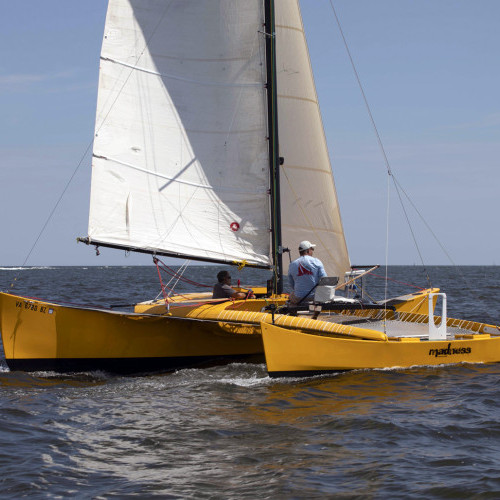
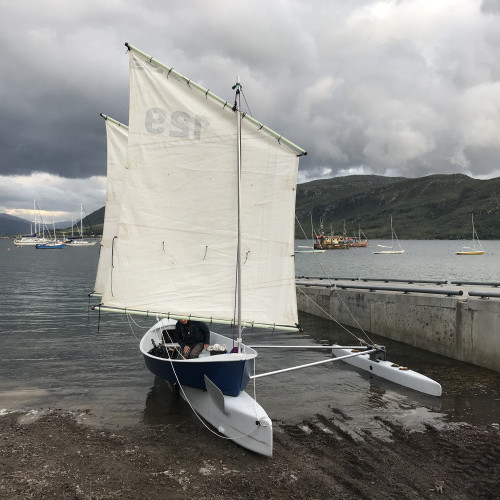
Sailboats are Leavers. A sailboat, by its very nature, cannot store up its motive power. It's a rare example of forced "Leaverhood". It catches the wind, and then lets it go. A wind powered vessel heads to sea carrying only the faith that the wind will be sufficient to make the passage. It doesn't know exactly how long it will take or how difficult, but it trusts that it will eventually get to where its going. That is a profound difference in attitude. A sailboat doesn't focus on limits, but on abundance. The amount of power available in the atmosphere at any time is always far, far greater than any boat can possibly use. A sailboat doesn't worry about "wasting" the wind. It doesn't parse out a meager ration, no, it only tries to catch a tiny fraction of the immense power available to meet its needs. It DOES need to be alert, or "present in the moment", if it hopes to take best advantage of the wind, but it absolutely never need worry about running out.

I once read about the Australian Aborigines and their attitude toward the land that sustains them. They speak of the remarkable abundance of their land, and their deep felt appreciation for its bounty. This is from a people who live on the most barren continent on earth (save Antarctica). Meanwhile, we who live in North America, a continent that once literally overflowed with natural abundance, feel impoverished, mean, and resentful. Like a powerboat, we are always planning for the future, for every eventuality. We focus on our fuel tanks (our money) and we have the sneaking suspicion that there is not enough money in the world to take care of all the eventualities. We forget to look up and see the abundance all around us - and it doesn't occur to us to take the free gift that is offered.

There is a Taker and a Leaver inside all of us. We've been listening to the Taker for centuries, and look where that has brought us. Maybe we could listen to the Leaver for a while. We could focus on the abundance, not on the lack. It's all in how we look at it.

Comments

  • The Australian Aborigines are an excellent example of a “Leaver” society.  When they arrived in Australia 40,000 years ago after being crowded out of Indonesia, they soon adapted to their new environment by “Leaver"ing behind (losing) the skills of their ancestors such as boat building and arrow making.  They became isolated from the rest of humanity and stagnated for all those millennium.

    The Polynesians shot half way across the Pacific from Celebes to Samoa between 1600BC and 1200BC.  The reason they spread out so fast was because of capitalism!  As new islands were discovered the Polynesians quickly exploited the new resources found there and set up trade routes.  Those trade routes led to bigger and better boats (including Proas) to transport the goods and people.  It led to navigation techniques that Europeans didn’t discover until much later.  (Although, apparently the Polynesians depended more on migrating birds than navigation to show them the way to new islands!)

    Read the Pulitzer Prize winning “Guns, Germs, and Steel (the fates of human societies)” by Jared Diamond, renowned evolutionary biologist and professor at UCLA school of medicine.  I’m now reading “Collapse (how societies choose to fail or succeed)”, his latest book.  It gives examples of collapses like Easter Island and the Anasazis, and reasons for hope for many present-day societies.

    I, myself, believe in the future and that technology will continue to overcome the challenges that would have caused human extinction long ago if not for our well-developed brains.  Only yesterday I read an article (http://www.msnbc.msn.com/id/7654627/) on “desk top” nuclear fusion.  Fusion is the virtually limitless power of the sun.  A power source that could fuel your car (or boat) for 10 years without recharging while being roughly the size of a grapefruit is now a distinct possibility.

    This is neither the time to squander our available resources nor abandon the progress we

    Posted by  on  04/28  at  12:36 PM
  • Spurred on by Michael’s comments, I just read Ishmael. Perhaps more than anything else, I was reminded of a seminar I attended a few years ago entitled “What Are We Really Teaching Our Children?” The idea of a culture enacting its story fits pretty closely with the theme of that seminar.
    I hope I don’t seem too contentious here, but I found the comment about the Australian Aborigines “stagnating” to be interesting. In the first place, one person’s period of stagnation can be another person’s period of peacefulness and contentment. It depends on your perspective. Secondly, the concepts of stagnation and lack of progress seem like a Taker viewpoint, don’t they?
    None of this is really new. It is just system theory put into different terminology. The Taker System requires an open system to keep up with the input requirements. The Leaver System is a closed system, which doesn’t require fresh inputs constantly. Of course, without fresh inputs, the Leaver System is prone to “stagnation.” Which I don’t believe to be such a bad thing.

    Posted by  on  05/04  at  09:59 AM
  • Well shucks, I’m glad you read it, Marc. I agree, that one man’s “stagnation” is another man’s contentment. If constant forward movement is required for happiness, than indeed the Aborigines must have been the most unhappy people on earth. Yet that is not how they describe themselves.

    As far as calling the Pacific Islanders “Capitalist”, well, I find it a stretch to call a bunch of people who owned nothing individually Capitalist. Sure, they traded and used the resources they found, but that is not Capitalism:

    Webster Dictionary of the English Language: “Capitalism is an economic system in which the means of production, distribution and exchange are privately owned and operated for profit.”

    The American Heritage

    Posted by Editor  on  05/05  at  05:02 PM
  • Did individual islanders own their own clothes, huts and most importantly, boats?  The key word in the capitalism definitions above (and below) is “private”.  These were people working on their own, utilizing their own resources, ingenuity and ambition to amass goods for their own family and for trade with others. 

    Princeton University WordNet defines capitalism as:  an economic system based on private ownership of capital [syn: capitalist economy] [ant: socialism]

    As WordNet states, the antonym of capitalism is socialism.  This parallels the underlying political philosophy.  In a capitalist society, private ownership is a fundamental right and the individual

    Posted by  on  05/09  at  01:10 PM
  • Well, what IS my point? That capitalism is “bad”? I don’t know. I DO think that the current world order doesn’t really suit us very well. The current world order pushes corporate capitalism and a global free market as the solution to the world’s ills, but I don’t believe that line anymore.

    I tend to think of rapacious global corporations as the ultimate expression of capitalism - but what are they really? Do they promote the concept of private ownership? It seems to me that they are really vast collectives - the stockholders “own” the assets collectively, with no actual personal private ownership of any one “thing” involved (especially ownership of responsibility and liability) - so maybe a corporation is the ultimate expression of socialism, not capitalism like they claim.

    As far as your experience of mediocre nationalized phone service in Brazil, I can assure you that privatized phone service in the US is probably the most frequently complained about service there is (and it was roundly criticized before it was privatized, so maybe people just love to complain about the phone company?!).

    Your view that more industrial capitalism/technology is the answer to all the problems it has created is a popular one, but I don’t share it. Trouble is, what would replace it? Well, you got me there. To hold up modern industrial socialism or Russian totalitarian communism as the only alternatives is not exactly thinking outside the box.

    Currently, I am thinking that social hierarchy is closer to the root of the problem, not any economic system per se. Peoples who live with fewer layers of hierarchy, with more direct access to those who who make the decisions that directly affect their lives - whether capitalist, socialist or tribal - tend to live more empowered, meaningful, and just lives, IMHO.

    Posted by Editor  on  05/09  at  03:21 PM
  • I agree.  When kelptocracies and global corporations feed off each other, the consumer loses.  I worked for Shell in the 70’s, Marathon in the 80’s, and had my own company in the 90’s.  I got tired of government’s confiscatory and controlling nature so I sold my company to the employees.  A large portion of Shell and Marathon payroll goes to entire departments devoted to non-productive tax, legal, and regulatory compliance (EPA, OSHA, FTC, DOT, and on and on).  Everything to do with government is overly complicated and fuzzy because of politics.  They should follow Einstein

    Posted by  on  05/10  at  02:41 PM
  • The core of this issue, as I see it, is whether or not we actually need what the big corporations provide for us or not. I have read many accounts of the conquests of the Native American peoples that placed the exact moment of the defeat at when the Europeans provided goods to the Native Americans that they could not provide to themselves, i.e. they were made dependent upon the trade goods.

    Much the same situation continues today. When a new line of goods is introduced, it is up to the marketing division to create the demand for it. How many goods do we now depend on that we cannot imagine doing without? Such as a car, in most areas of the United States at least. A city has to be very large to have a decent public transportation system, yet public transportation is generally one the prime solutions offered for many of the problems we face today. Such as oil consumption, air pollution, and highway congestion.

    I do agree that in the actual timeframe of the planet, which is to say geologic time, we as a species only represent a small blip in the lifecycle. We like to think that we, the humans, are at the top of the food chain. We are convinced that we are more important than we are. I don’t believe that science and technology is going to save us. It may buy us a little time before the Earth moves on with or without us. My bet is that it will be without us. At least, without anywhere near as many of us than are presently living on this planet.

    Posted by  on  05/19  at  02:20 AM
  • many of the early Europeans writing about the Australian Aborigines described them as the happiest and most contented people on earth.

    I’d say MArk is a Taker

    Posted by  on  07/13  at  03:20 AM

Post a New Comment

Commenting is not available in this weblog entry.