Two if by sea. |
Recent PostsThe Last Navigator Finds His Way HomePoetry in Motion - C Class Catamarans Anthenea New Seaclipper 20 Aye, Calypso! Proavocative Art Documenting the History of Modern Multihulls - Before It’s Gone Traditional Vaka Heading East Bernard Smith, 1910-2010 End Game Journal CategoriesAll CategoriesMonthly ArchivesJuly 2010June 2010 May 2010 April 2010 February 2010 January 2010 December 2009 November 2009 October 2009 September 2009 August 2009 July 2009 June 2009 May 2009 March 2009 February 2009 January 2009 December 2008 September 2008 August 2008 June 2008 May 2008 April 2008 March 2008 January 2008 December 2007 May 2007 October 2006 March 2006 January 2006 November 2005 October 2005 September 2005 August 2005 July 2005 June 2005 May 2005 April 2005 March 2005 The Crab Claw Tee
|
ProasTesting With Models - I
Posted by on 03/01 at 02:52 PM
From the Proafile Archives. Originally posted 1999 After the disastrous first sail of my 26’ proa Rozinante, and after waiting a suitable time for my emotional wounds to heal, I decided I needed to do some research and testing. Research was easy, since there is practically nothing out there to read on proa design. One notable exception is the Amateur Yacht Research Society (AYRS) which has published many a paper about proas over the years, and is one of the few yacht design organizations that treats proas as a legitimate area of interest. I became a member post haste.
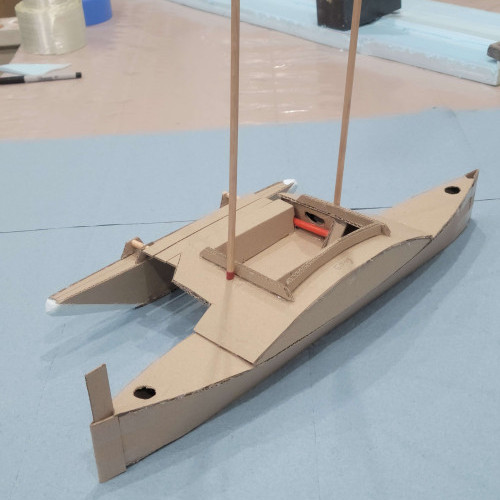
The Book of WisdomOne AYRS publication in particular; Design for Fast Sailing by Edmond Bruce and Harry Morss (AYRS 1970), I found to be brimming with useful and thought-provoking stuff. The book covers everything from basic sailing theory to the nuts and bolts of making performance measuring instrumentation (That part is a bit out of date). Chapter subjects include Designing for speed to Windward; Optimizing Sizes of Centerboards; Backyard Tank Testing; Sail Models; Hydrofoils for Anti-Heeling, Lift, and Steering; and one that especially caught my eye, Testing for Balance of Sailing Craft Using Small Models. The book is peppered with references to proas, and indeed, the ultimate yacht visualized in the last chapter turns out to be a proa. Scale models, it turns out, sail exactly like the real thing! ...as long as you keep some important points in mind. They are excellent for fast and cheap testing of unusual concepts, in order to get a feeling if the basic idea has merit. Proa geometry is so poorly understood by Western naval architecture, that the gross arrangements of sail, hull, outrigger and leeway preventer are still wide open to debate, and experimentation. Models are useful for testing helm balance, trim, stability, and relative speed. Best of all, you can go through dozens of variations in less time and at a fraction of the cost of making the real thing. You cannot scale up the model's speed to full size with any degree of accuracy without lots of tedious math, but you can compare one model's performance to another. Foil sections do not scale well, since Reynold's Number effects dramatically change the properties of smaller vs. larger foils, rudders, hulls, and sails. Though foil sections will change with scale, their placement in the boat and their effects on trim and balance will remain the same. Inspired by the AYRS, and the fact that my new guru, Edmond Bruce, thought very highly of using small models to test sailboat concepts, I got busy. I built a 1" = 1'-0" scale model of my 26' proa out of balsa and foam, and laminated a layer of fiberglass over it using polyester resin, all materials purchased from the local hobby shop. It took me about a week of evenings to finish. Polyester resin really stinks up the apartment when it cures, so don't use it. Later I found some epoxy resin suitable for laminating fiberglass, and used that instead. My first model would test rig configurations. The current rig on Rozinante, a Bolger proa rig, (see Figure 1) was an utter failure. I will leave the analysis of the Bolger rig for another time. After my disheartening experience with such an unconventional approach, I was in a much more conservative mood. The Schooner
I made the rig in one afternoon, using lightweight spinnaker cloth (rip-stop nylon) for the sails, and wood dowels for the spars. I taped the sails together, making luff socks to go around the masts. I decided sprit booms would make the sails easy to trim, and indeed, the sails set and trimmed very well. I can see why sprit boomed sails are so popular on small boats. To steer, I wanted to try twin daggerboards, placed fore and aft in the hull. I would adjust the boards to move the CLR fore and aft , which would steer the boat. No radio-control was used, because a goal of my testing was to get the proa to self steer on most courses. A free sailing model would show whether or not this was possible. My first tests were carried out from a friend's dinghy, on a small lake. This was a bit unwieldy, since it is hard to row and catch a sailing model at the same time. Later, I found an ideal model test pond in a public park. It was not too obstructed by trees so the wind could reach it, and it was a uniform one and a half feet in depth, so I could wade after the model if it didn't make it to the other side without capsizing. I had to pull the forward daggerboard all the way up, and put the aft one all the way down, in order to get the model to sail straight and not luff up into the wind, because the schooner rig's CE is considerably aft of the hull's. In order to fall off the wind, I let out the aft sail a bit, and then it would balance on a reach. I noted that there was a slight but definite bow-down attitude with this rig, that grew more pronounced with more wind. I tried sailing the boat both as a Pacific proa, with ama to windward, and as an Atlantic proa, with ama to lee, since it was easy to switch with the cat-schooner rig. Predictably, the Pacific proa was faster in light winds, but was also considerably more tender, and thus susceptible to capsize. After a few near capsizes in the full-sized Rozinante, I was definitely looking for a more stable solution. I wanted to test the ama to lee Atlantic proa, since that configuration seemed to offer greater righting moment. The Atlantic proa initially had better helm balance with this rig, since the drag of the leeward float tended to counteract the weather helm of the schooner rig. The bow daggerboard could be partially lowered to achieve a course steered to windward. I noted, however, that the helm balance changed depending upon wind strength and ama immersion, so the self steering was not very good. The boat would sail a meandering path across the pond, sometimes sailing so deep onto a broad reach that it would not come back to the intended close hauled course, and would get caught aback. Self steering was better with the ama to windward. My ama was only 20 inches long, compared to the 26 inch hull, so the bow down attitude was quite pronounced with the ama to lee while on a reach, and the boat would pitchpole easily if a stronger gust hit. One course of sail that the schooner rig excelled at was dead down wind. I could adjust the sails to set wing & wing, and then fine tune them so that the boat self steered very well, adjusting to changes in wind direction with uncanny ability. I could picture hours of happy down wind sailing and surfing with this rig. With the cat-schooner configuration, I seemed to have a choice. Sail with ama to windward and capsize in the puffs, or sail with ama to lee and pitchpole in the puffs. Hmmm. I decided a much longer ama might work, so I replaced the 20" ama with one 26" long - to match the hull. This worked somewhat better, but still, that pesky bow down attitude was there, so I knew that pitchpoling was just a matter of the right gust and the right wave. The problem with a proa, when compared to a trimaran, is that the tri can place the buoyancy of the ama forward by making the bow much fuller than the stern, to counteract the diagonal downward pitching moment of the rig. The proa, by definition, must keep the center of buoyancy actually centered fore and aft, so it will not be as resistant to this diagonal pitching force. To make matters worse, tacking boats are designed with their CG aft, which again helps keep the bows up. Proas must have the CG in, you guessed it: the center. Crew weight shift aft can help, but of course my model has no crew. Dynamic Lifting Ama
Ama - XL
What else had I learned? That proas were not such an easy nut to crack, that's what. The longitudinal symmetry of the hulls means that a proa has to be long in relation to its sail's CE to avoid sailing bow down. Much later, I realized that a proa is first and foremost a canoe. A long and lean minimum resistance sailing machine that does best without an overpowering sailplan. Modern racing multihulls are just about the opposite of this, with massive sail areas, ultra wide beam, and intense structural loads. I had always thought that Dick Newick’s Cheers looked woefully under-canvassed to my eyes used to seeing much taller rigs on multihulls. Now I know that Cheers didn't need more sail because it was incredibly long and light. Proas go after speed by reducing weight and drag, rather than by increasing sail area and power. Now, I think that a sailing sea kayak would be a better place to come from in getting to a proa, rather than a modern sailing multihull. Anyway, by now I had another plan... The Bruce Foilers
It didn't work, not even a little. Since, as you recall, the boat tends to sail bow down, The leeway angle was not enough to overcome the bow down angle, and the foil created negative lift. It acted like a shovel and instantly dug the ama under water, causing a pitchpole. It appears that the foil suffers from the same pitching moment that effects an ama. The solution with the ama was to make it long enough to effectively counter the moment. The solution with the foil was to position it forward of center. I cut off the 20’ ama, and replaced it with a square sectioned float, rotated at a 45 degree angle, to make a diamond. This gave me the flat mounting surfaces I needed for the 45 degree angled foil. I made an oval shaped foil, and mounted it with an adjustable screw so that it could swing back and forth, like a leeboard. I also made the crossbeam lengths adjustable, since Bruce said that the distance of the foil away from the rig center of effort was fairly critical for success. Success
I experimented a bit with the distance of the ama/foil from the hull by adjusting the crossbeam lengths. Pushing the beams in, the foil would run deeper and deeper, until it couldn't lift the ama out of the water. Pulling the beams out, the foil would ride higher, until it was barely in the water, however then the boat would make too much leeway. It appeared that Edmond Bruce was correct, and the beam of the foil stabilized proa is an important number to get right. I enjoyed many trips to the pond with this model, watching it perform. The speed was thrilling, but gradually I discovered some negative traits:
The Tacking Test
The downside was the other tack. If the boat could not be shunted, then it must tack, which meant the hydrofoil would be on the windward side. I could never get this to work reliably. The boat would start sailing along, with the foil pulling down, not up. This kept the boat upright, for a while. But invariably, a sudden gust would lift the foil out of the water, and over she would go. Obviously, the tacking Bruce foiler was impractical, but why did the longitudinally asymmetrical foiler outperform the symmetrical one with the foil to lee"? My theory is that it all comes down to the center of gravity. When a Bruce foil is powered up, the foil is exactly counterbalancing the capsizing force of the sail. The foil is doing most of the work, resisting leeway, and creating lift. The main hull is mostly just along for the ride. The hull's main function at this point is to control pitching and yawing forces, which helps the foil run smoothly. If the foil is parallel, or nearly so to the longitudinal CG as it is in a proa, then the forward pitching moment of the sail will cause the boat to sail slightly bow down, and especially on leeward courses, that can invite a pitchpole. If the sail is well forward and the CG aft, as in a tacking boat, then there is plenty of weight aft to keep the bow up, which keeps the foil well away from any dangerous negative angle of attack. Think of the hull like a teeter-totter, with the pivot being the Bruce foil. Move the pivot off center, and the teeter-totter will no longer teeter, but quickly find its most stable position with the long end firmly on the ground. The tacking foiler is analogous to the off center teeter-totter, with the stern being the long end. It appeared that major longitudinal adjustment of the foil, and probably of the rig, would be needed to make the Bruce foiled Atlantic proa reliable. I sketched lots of variable geometry schemes with this in mind, and built several models of these. In the end I decided that all the work needed to make the boat sail reliably as a Bruce foiler just wasn't worth it. It would have required new, longer cross beams, probably a new ama, a fore and aft foil sliding mechanism as well as one for retraction, and a new rig concept as well, one that would put the CE further forward, perhaps a balestron rig. What I needed for a foiler was a little 16' test bed, not a 26' boat that was already built. I reluctantly put away the Bruce foil models, (thinking that some day I would return to these fascinating foils) and went back to the drawing board. How was I going to make Rozinante sail properly without completely rebuilding her? Comments
Post a New CommentCommenting is not available in this weblog entry. |
ResourcesKat & ProaWakataitea Tiki 46 Apacolypso Designs Siam Sailing Roxane and Romilly Tom Speer’s Shunting Foil Sections Boat Bits Lunada Design Tacking Outrigger Seventy Point Eight Percent Arpex Inigo Wijnen Slider Cat Chine Blog Amateur Boatbuilding Out Your Back Door Outrigger Sailing Canoes Sailing Anarchy Canoes of Oceania Never Sea Land A Tiki in Thailand Canoe Sailing Magazine Wikiproa K-Proa Triloboats Cheap Pages James Francis Boats Proa Web Sites Peak Energy Balogh Sail Designs Hydrovisions Cape Falcon Kayak Multi Marine L-7 Crab Claw Catamaran Mehrrumpfboote Openboat Oar Club John Welsford Small Craft Design Global Rich List Skinboat School OCPaddler.com Jubilee USA Network Zephyr Kayak Sails Chesapeake Light Craft Nigel Irens Design Tarawa, a Proa For One Polynesian Voyaging Society McGowan Marine Design RealClimate - Climate Science Small Sailboats UK |