Two if by sea. |
Recent PostsThe Last Navigator Finds His Way HomePoetry in Motion - C Class Catamarans Anthenea New Seaclipper 20 Aye, Calypso! Proavocative Art Documenting the History of Modern Multihulls - Before It’s Gone Traditional Vaka Heading East Bernard Smith, 1910-2010 End Game Journal CategoriesAll CategoriesMonthly ArchivesJuly 2010June 2010 May 2010 April 2010 February 2010 January 2010 December 2009 November 2009 October 2009 September 2009 August 2009 July 2009 June 2009 May 2009 March 2009 February 2009 January 2009 December 2008 September 2008 August 2008 June 2008 May 2008 April 2008 March 2008 January 2008 December 2007 May 2007 October 2006 March 2006 January 2006 November 2005 October 2005 September 2005 August 2005 July 2005 June 2005 May 2005 April 2005 March 2005 The Crab Claw Tee
|
Contributions ProasCrab Claw Tests
Posted by on 01/21 at 09:04 PM
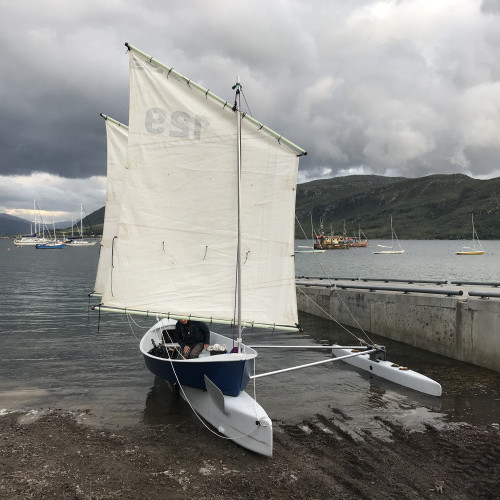
Nicholas Schneider sent me some results of his crab claw rig experiments, which are posted below. Thanks Nic!![]() ![]() ![]() Description of rigs in drawings: B-H all had characteristics beyond my sailing experience. D sailed without sheet, assume CP at mast and movement of aerodynamic center with changing AOA trimmed sail as I steered with dead helm. Sailed both F and G3 same day in higher wind and open water chop and gentler conditions in harbor where G3’s larger area had some advantage but generally similar performance, excepting asymmetry of G. Tell-tails of video tape applied to D-H and generally formed as in drawing. 1 floats above all, 2 and 3 spiral aft, slight drift to leeward, once neatly twisted up and unwound on opposite tack, 4 rises up to join them at best trim, 5 steadily streaming aft, 6 sagging slightly. Rounding up puts all streaming aft, falling off, 1-6 float to leeward and most in lee field hunt forward. Tell-tail chafe greatest on leading edge between apex and mast, and in trailing vortex. Good gusts produce a tighter vortex, there is a delay in acceleration until it forms. H, with camber to leeward has 3, 4 and 5 rise up along trailing edge to spiral. Sailing F with flat foot in harbor 10-15KT wind, best tack was with mast and strut to leeward, opposite tack best in 15-20KT in bay pounding up wind with weather helm and tell-tail 5 rising up to join 2-4 in a more compact back flowing spiral. Assume high speed flow may extend vortex further aft. In harbor weaker vortex may be assisted by disturbance of supports. Flipped mast and strut to opposite side, performance followed suit. Varied sweep angle of D and F to improve windward ability. D and F sailed flat footed and loose footed for lower edge camber. Flat F sailed with leeward lower end plate which brought low line of leeward tell-tails parallel with boom. Rolled top spar to develop twist. All results, perhaps too nuanced for my variable conditions, were inconclusive. Seems less camber is best, easing or loss of tensioning device has adverse effect yet wing favors camber side and good high wind performance may result from increased camber in loaded fabric. Removal of lower aft area, sheet tension and helm indicate effective area of sail is forward yet slender wing’s center of pressure should be further aft. Suspect mast disturbance but clean wing has same characteristics. Telltails were quite useful during sailing,but better studied with boat beached, or better yet, indoors at 1/12 scale on tabletop with grated fan and cassette tape tell-tails on and around sheetmetal planforms. Formation and position of LEV and some surface flow direction and pressure can be visualized. In 1/12 model of H, using moveable telltail on wand in 6 MPH flow, cassette tape slides over top of LE and rolls into vortex on lee surface below with rapid rhythmic slapping; tape streams under and a detached vortex forms below and leeward of bottom edge, large drag inducing tip vortex? The small differences between sharp clean wing and sail rig with its high parasitical drag, and the small differences in performance between D and F with its reduced SA favors this area for improved L/D. Combined vortex and potential[conventional] lift puts CP aft of mid point in symmetrical delta wing studies. Half delta large tip condition compromises conventional flow causing forward CP as confirmed in sailing,but be skeptical. Adding tapered end plate, or pitching apex end up 20 degrees, lifts bottom vortex up onto lee surface. At 10 degrees AOA weak top and bottom vortices, conventional flow in mid aft section; 20-40 total vortex and best suction; 50 less suction and bottom detaching; 60 total separation. With flat to leeward 10-20 conventional flow; 30 transition; 40-50 middling vortex action; 60 detached. Results loosely concur with sailing experience. In models, LE with straight or curved sweepback, with sharp, round, blunt, even end plates all easily formed vortices but planform, streamwise camber and kant may help maintain attachment. In general at 20-40 AOA vortex detaches out toward streamwise flow at ½ LE, suspected drag of long telltail but short ones indicate the same. In B model LEV forms on lower half of LE and detaches out and bends down to horizontal streamwise flow at mid level, leaving tip area in somewhst confused conventional flow. Surprised it sailed so well; I might be missing something here. More sweepback, streamwise aft camber and kant twisted to leeward toward tip follows vortex trajectory delaying separation. Looks good but no idea of L/D consequences. Other than B, these rigs handled poorly but always got me home. Sunfish hull not ideal and focus of study was drag reduction but conclusions should apply to any LEV sail. The crab claw in low position, lower spar parallel to streamwise flow, produces large tip vortex and, as sweepback is reduced, spar increasing becomes a blunt trailing edge and LEV eventually fails to form on increasingly vertical LE. Yet sail performs with this theoretically poor design indicating much to learn and potential for improvement. Time for sailing. I have sail rig F and wing H in need of a low drag platform in measurable conditions. It is winter: ice, wind meter, GPS and an iceboat would give me a speed ratio; big work for a small number. Comments
Post a New CommentCommenting is not available in this weblog entry. |
ResourcesKat & ProaWakataitea Tiki 46 Apacolypso Designs Siam Sailing Roxane and Romilly Tom Speer’s Shunting Foil Sections Boat Bits Lunada Design Tacking Outrigger Seventy Point Eight Percent Arpex Inigo Wijnen Slider Cat Chine Blog Amateur Boatbuilding Out Your Back Door Outrigger Sailing Canoes Sailing Anarchy Canoes of Oceania Never Sea Land A Tiki in Thailand Canoe Sailing Magazine Wikiproa K-Proa Triloboats Cheap Pages James Francis Boats Proa Web Sites Peak Energy Balogh Sail Designs Hydrovisions Cape Falcon Kayak Multi Marine L-7 Crab Claw Catamaran Mehrrumpfboote Openboat Oar Club John Welsford Small Craft Design Global Rich List Skinboat School OCPaddler.com Jubilee USA Network Zephyr Kayak Sails Chesapeake Light Craft Nigel Irens Design Tarawa, a Proa For One Polynesian Voyaging Society McGowan Marine Design RealClimate - Climate Science Small Sailboats UK |