Contributions
FatCat21
Posted by on 03/14 at 08:48 PM
Chris Ostlind presents a catamaran design for plywood stitch and glue construction that continues the Manu Kai theme.
Just a few months back, our Proafile host, Michael Schacht, introduced a set of concept illustrations for a very nice, 23' Hawaiian flavored catamaran called, Manu Kai.
Michael's vision was at once elegant in the manner in which it honored traditionally styled Hawaiian sailing vessels and it provided a set of unique solutions for how to blend the traditional with the modern in boat design.
Below the text of the article in the section for comments was a note from the author about the difficulties of designing this type of hull for a plywood build style. Since I design a lot of boats for stitch and glue plywood construction, I was immediately curious as to just how far down the path of the Manu Kai I could actually go with a possible design from that material/technique.
Coincidentally, I had been developing a pair of plywood cats at 21' and 24' that would be legal for trailering while providing energetic cruising potential for the owners. Taking on a challenge, like the Manu Kai form, seemed like a logical extension of the design process, so I pushed myself up to the computer to take a whack at Michael's high standards.
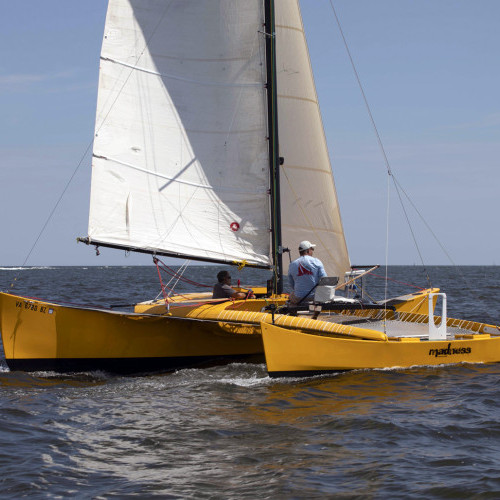
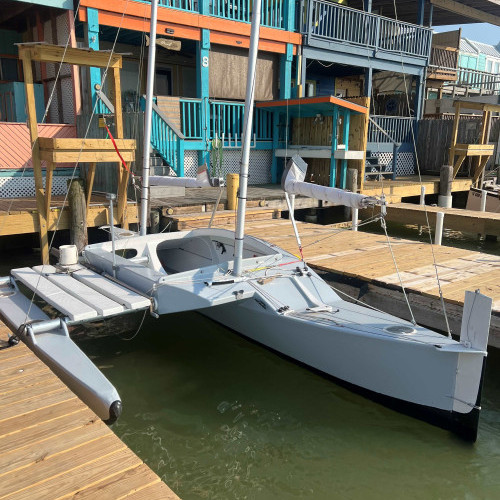
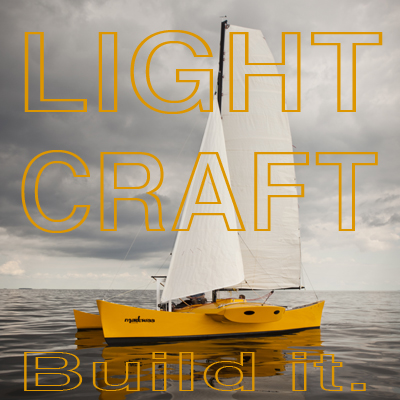
The result is the FatCat21 pictured here.

Much of the territory explored by Michael has been addressed in this design with some exceptions for pragmatic materials use and simplicity of build. For instance, I did incorporate an upswept bow horn to establish a definite nod to the traditional Hawaiian, paired canoe forms from the past, but I dropped the canoe hull stems in the stern in favor of a transom build. This gives the stern more room for an emergency flotation chamber, slightly more room for interior applications like a single bunk for a kid and a very standard method for mounting beach catamaran rudders.
I changed the rig to a Gaff setup to set the design apart a bit from Manu Kai's Gunter, while still drawing on the trad look of older sailing boats. The boat could just as easily be equipped with an affordable, modern and easily acquired Hobie20 rig if the owner so chose.
The displacement of the FatCat21 is set at 1850 lbs. This allows a significant load carrying capacity of 1000 lbs. over the estimated finished hull weight. I was targeting the load requirements on this boat to accommodate a family of four (mom, dad, a couple of small kids) on a long weekend, or two adults for a more extended coastal cruise. In case you're wondering, I am not suggesting that this boat should be used for crossing oceans.
Build style is a very easily managed, stitch and glue style with external forms to hold the panels while they are being wired together. I am indicating a full, epoxy/glass laminate on the inside as well as outside of the hull. The three beams are owner built, glass re-enforced, box structures with one box beam able to slide inside the other to compact the boat for trailering. Sailing beam is 11'
FatCat21
Specifications
LOA: 21'
BOA (sailing): 11'
Beam (trailered): 8'6"
BOA (hull): 32"
BWL (hull): 21.5"
Displacement: 1850 lbs.
Sail Area: 251 sq. ft.
The hulls each have substantial spray chines about midway from the water to the deck inside and out. These will provide considerable wave and spray deflection underway and enhance the ride comfort. They also enlarge the interior volume so that anyone dropping down into the hulls will not have to move sideways to dig through their gear.
When I looked at the Manu Kai's integrated keel forms, I saw a perfect solution to something I'd been haggling with in the original FatCat design� What to do with the daggerboard/centerboard trunks so you could still get some useful space down below? I'm still going to offer the other board solutions to builders if they seek more performance from their boats. I just feel that the integrated keel form presents a very viable solution to boaters who are, shall we say, a little less attentive, when approaching a shore. Nobody likes the thought of clipping along at 10 knots and driving your boat onto the beach with the daggerboards still down. So, the integrated keels will do wonders for the sailors who don't mind losing few degrees of headway in exchange for peace of mind in thin water.
I did change the rudder design and it has more to do with my personal preference than anything. Spade rudders are more efficient for a given size. They work off the hull as an endplate and have none of the cavitation issues one might experience with transom hung units. They are, however, much more susceptible to damage from underwater obstacles. Some of the concern has been addressed in the integrated keels of the Manu Kai design and for good sailors who pay attention, this will be a great solution. For others, (and that includes me) who don't always pay close attention when sailing, transom hung rudders can really save your boating vacation, as well as your pocketbook, if you drive up a beach or tiptoe over reefs. I'm specifying transom-hung rudders of the flip-up variety for that reason
There are footwells in the aft hull decks so that when the boat is driven, the crew does not have to lay their legs out straight on the bridgedeck. The sitting couches can be folded down for travel or removed completely from their mounts and stored in the hulls. The bridgedeck, itself, is a series of component platforms that can be removed for trailering.
There is a drawing for an additional, modular spray shield that installs across the main forward beam to give further comfort while under sail. Much like the Manu Kai, the motor can be carried in a pod amidships or simply hung from the aft beam according to owner wishes.
Below decks, there is ample room for a couple kids to sleep in each hull, storage for gear and room to setup a porta-potti if so desired. I also feel the bridgedeck is the place to hang a boom tent or setup a mountaineering tent. The boom tent option is especially powerful for anchored locations as it would full enclose the hull pods as well as the large deck, making for a really roomy camping cabin.
Plans for the FatCat21 are not completed� yet. In the meantime, I'd love to hear comments and/or constructive criticisms on the design as I would like to incorporate anything powerful before I sit down to finish the working drawings.
Chris Ostlind
Lunada Design
Comments
Chris, nice boat. Are you saying than below-decks will sleep only kids? No adults?--Wade
Posted by on 03/16 at 11:50 AM
Hi Wade,
Thanks for the comments.
An average sized adult could sleep below decks, though they wouldn’t be calling their cozy little zone spacious. I was looking at this boat as a compact, young family cruiser. You know, Mom and Dad around thirty years old and a couple of kids under 12. You could stash the two kids in the hull for the night in their sleeping bags and then Mom and Dad could have a certain measure of privacy in a spacious boom tent on the bridgedeck.
With that arrangement, the adults could, conceivably, get the boat on the water again in the morning without waking the kids. Now, maybe I’m just doing a recollection of how things used to be in my family when my kids were younger, but I would have oved to own a boat like this one when the kids were smaller.
Now, my son is bigger than I am and our daughter has gotten oh-so-picky about where she’ll sleep. The times do indeed change…
Posted by Chris Ostlind on 03/19 at 08:21 AM
Hi Chris,
nice design! I like your concept for the interior arrangement and proportions.
Best,
Peter
Posted by on 03/19 at 12:08 PM
Hi Chris:
This looks very sweet! Obviously this is quite different from the full cabin 21 footer we had communicated about some time ago. I like this design a lot. It appeals to me on many levels and I like the idea of the integrated keels as well. I think its a great practical solution and it fits in with the clean design.
Robert Irizarry
Posted by on 03/19 at 01:46 PM
Very smart job Chris - I think a lot of people would be proud to build and own a cat like this.
Gav
Posted by on 03/20 at 05:32 AM
Geez, thanks, guys. It’s nice to have a full compliment of critical eyes brought to the game.
Posted by Chris Ostlind on 03/20 at 04:40 PM
Chris - Are you still considering a cabin version of the FatCat21 with a fixed trailerable width or have you dropped that idea in favor of this one? I definitely see the advantages to stability with this design but I’d still be interested in what you were considering in terms of the cabin design. I would imagine it would be an easier sell for with the wives.
Posted by on 03/22 at 07:14 AM
Very intereted in the last chap’s question regarding a possible fixed width cabin version despite the obvious compromise in performance.
Posted by on 04/04 at 05:48 PM
Plan timeline? Estimated plan cost? Great boat as is. Am most interested. thanks
Posted by on 04/04 at 06:23 PM
While I’m no designer, I did build a similar style 21’ cat years ago in Hawaii. Granted I scrounged outer hulls from a old Piver trimaran and connected them with a ply solid deck and added small cabins in each hull. I too designed and built a forward crossarm. I found in heavier seas that forebeam tended to bury itself in the wave face as she sailed into them. Scary...I cut it off leaving my forward hulls free to take seas better if necessary without that beam acting like a brake and “plowing”. She still sported a forward net and jib off a cross wire. I admit we were scary sailors back then taking her out in far too rough conditions. The other thing that almost sank us once was taking water in over the lee side into the cockpit - again in heavier conditions. We did not have any self bailing system in place and had to manually bail which meant putting a crew’s body weight on the wrong side in poor conditions. Finally we sailed her to a standstill one day in near hurricane offshore winds. While drums, foliage and chickens rolled accross the surface in a cloud of spray we sailed up and down the bay until the mast snapped off at the three-foot mark.
One question. I’m one that can’t sit on tramp anymore due to hip problems, I enjoy a proper foot well. What about a “third” center footwell hull with an underdeck hull shape just deep enough to accomodate a couple of crew’s feet - say a 3’ by 18” and just kissing the water’s surface? Perhaps it could be the permanent center portion of the deck that the hulls slide up against for trailering.
I’d love to build this boat - let me know as soon as you have the plans ready! Obviously I’m a far wiser more sedate sailor with thirty years added experience, so never fear, I’ll do you proud...PS: I sail in Colorado and Utah on reservoirs and the Great Salt Lake.
Posted by on 04/04 at 07:04 PM
Hi Eric,
Thanks for all the comments. Please make use of my attached email address. I live in Salt lake City and have a prototype shop where I build some of my designs for testing.
Chris
Posted by on 04/06 at 06:57 AM
Hi Robert,
I have not dropped the fixed trailer width, full cabin version from the design portfolio. I just expanded my envelope to take in a boat that was my plywood interpretation of Michael’s very cool ManuKai design.
The 8’6” beam, FatCat21 is still very much in play as a buildable project.
Chris
Posted by on 04/06 at 07:04 AM
Chris,
Cool iteration of the FC concept. I think the nacale hulls and the boom tent fills a neat niche in the market. There are already some Jarcat type boats out there, but few designs like it. Much larger than the H 21 SC, but still trailerable. If I didn’t have the self imposed trailering restriction that necessitated Spike, I’d be seriously considering this boat as the fin eases lots of concerns about shallow draft obstructions. Expanding the beam seems like a logical step even if it somplicates it somewhat. Probably worth it both for the room and the righting moment.
Dan
Posted by on 05/05 at 07:35 AM
Nice lines! Would you be open to a 48’ version? Also, most of what I read about hull design states an elliptic(ish) underwater shape for best performance - are these guys splitting hairs for the average performance oriented sailor?
Jerry
Posted by on 10/19 at 03:05 AM
Preety nice,i would consider small keels like on a dart or some kind of leeboards.
Posted by on 11/05 at 10:16 AM
Dear Chris,
I spoke to you months ago about plans for the plywood catamaran designs. You were going to send some study drawings but my e-mail address wasn’t receiving. This is a new e-mail address. Please send some info and price structure. thanks,. John wadman, Custom Marine Services, Naples Florida
Posted by on 05/22 at 01:58 PM
Post a New Comment
Please avoid clicking more than once.
|