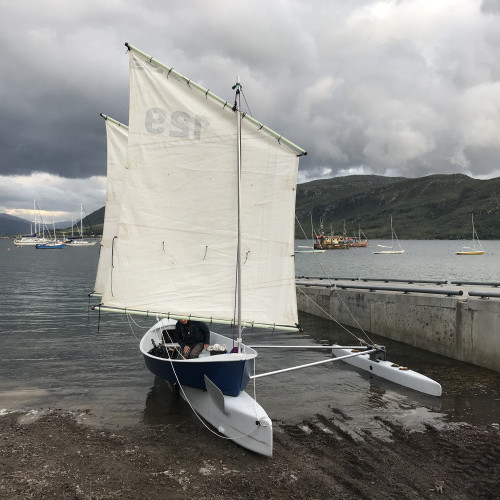
Two if by sea. |
Recent PostsThe Last Navigator Finds His Way HomePoetry in Motion - C Class Catamarans Anthenea New Seaclipper 20 Aye, Calypso! Proavocative Art Documenting the History of Modern Multihulls - Before It’s Gone Traditional Vaka Heading East Bernard Smith, 1910-2010 End Game Journal CategoriesAll CategoriesMonthly ArchivesJuly 2010June 2010 May 2010 April 2010 February 2010 January 2010 December 2009 November 2009 October 2009 September 2009 August 2009 July 2009 June 2009 May 2009 March 2009 February 2009 January 2009 December 2008 September 2008 August 2008 June 2008 May 2008 April 2008 March 2008 January 2008 December 2007 May 2007 October 2006 March 2006 January 2006 November 2005 October 2005 September 2005 August 2005 July 2005 June 2005 May 2005 April 2005 March 2005 The Crab Claw Tee
|
ProasRig Options - Crab Claw
Posted by on 03/07 at 01:02 PM
Overview of the potentials and problems of the remarkable rig of the native Pacific proa. Originally posted 2001. Updated March 2005. The Traditional Oceanic sprit rig (aka crab claw) has, in Western eyes, been considered a romantic if not particularly effective rig that most likely compared to the Mediterranean lateen in aerodynamic performance. That is, until famed sailboat aerodynamics researcher C. A. Marchaj published this startling graph in his research paper Planform Effect of a Number of Rigs on Sail Power.
Marchaj, under a grant from the Overseas Development Administration of the United Kingdom, tested the efficiency and power of various traditional rig types utilizing models in a wind tunnel.
Marchaj theorized that the crab claw develops lift in a different way than the standard Western Bermudan. It operates in what is called *vortex lift* mode, which creates powerful spinning tornadoes of air off the leading edge. The spinning vortexes are zones of intense low pressure, and thus lift is created. It is beyond the scope of this article go into the details of crab claw sail aerodynamics, but if you wish to learn more, Marchaj' book Sail Performance (Adlard Coles Nautical 1996) is highly recommended. Editor's Note: Since the publication of Marchaj's theory of vortex lift generation, there has been much discussion and some experimentation with the crab claw. The vortex lift theory has been questioned. Other experimentors have been unable to duplicate Marchaj's test results (though I am not aware of any wind tunnel tests that exactly duplicated the methodology of Marchaj). The crab claw sail varies considerably from the delta wing that Marchaj uses to justify his vortex lift theory. It may well be that the high lift of the crab claw is due to factors not yet well understoond. Marchaj's paper was very much a "The Emperor Has No Clothes" sort of wake up call to those who believe the modern Bermuda rig is the epitome of aerodynamic progress. His tests showed that the crab claw was not the only traditional rig that could outperform the Bermudan on some courses. A lateen was superior to windward, and the gunter, sprit, and lugsail were all superior overall to the Bermudan. The above notwithstanding, the Bermudan with a small jib tested very well close-hauled, second only to a lateen in Lift to Drag (L/D) ratio. The modern sport of yacht racing has developed around the triangular race course, a course that highly favors windward sailing efficiency. It is little wonder then that the rig most favored is one that is at its best to windward. The Bermudan tested very poorly on off wind courses however, and that fact is born out by racers needing to carry all manner of off-wind sails to augment the performance of the basic windward rig. It has also been pointed out that very fast sailboats, such as racing multihulls or ice boats, create so much apparent wind that they are always sailing close-hauled, and therefore, it's the L/D ratio that really counts, not the max Lift Coefficient. Crab Claw PotentialThe crab claw has the potential to become a desirable cruising rig for many types of sailboat, not just proas. The rig has these potential benefits:
Areas for ImprovementPromising as the rig is, there are certainly areas that could use study and further development. Close-hauled abilityThe crab claw is inferior to the Bermudan, no doubt. Not by much, but enough so that in a mainly windward race such as a triangular race course, the Bermudan would win. I am not aware of any modern attempts to improve the crab claw's weatherliness, but I am sure that such an effort would lead to considerable gains. Consider the 'claw to be at the equivalent development point of the first Windsurfer rig, in the 1960's. "It appears that there is actually a good deal of room for development, and study of the rig indicates that there are three main areas open for improvement: sharp leading edges, reduction in parasitic drag, and the specific shape of the sailplan. ReefingPacific Islanders apparently never reefed. There are no reef points in traditional Oceanic lateen sails. Instead, the Oceanic sailors developed a system of brails or "spilling lines". These are two lines that are tied on about 3/4th of the way out along the boom. They are then run on each side of the sail through deadeyes or blocks located on the mast top, and then down to deck, where they are either hand-held or cleated, depending on wind conditions. These lines serve several purposes;
Things get even more interesting if the windward brail is tightened. Efficient lift requires a relatively flat sail. By tightening the windward brail, the sailcloth is forced into a very deep curve, effectively cutting drive. At the same time, more of what power remains is directed upwards as lift, so overturning force is diminished even further. The effectiveness of these measures is apparently so high that the Oceanic sailors never felt the need to develop any sort of reefing system.
Left: Oceanic canoe with spilling lines shown in blue. Right: Windward spilling line tightened, which causes a deep curve in the sail shape. This reduces the drive of the sail and the effective sail area. Off-Center PullThough the rig is well-balanced on traditional proas while on windward courses or reaching, as the wind becomes more abaft the beam and the sheet is eased, the sail creates powerful weather helm, so that a steering paddle or rudder is required to maintain course. Shunting Ease and SpeedThe rig is not easy to shunt, mainly because the heel of the yard must be moved all the way from one bow to the other every time. Concurrently, the mast is pivoting forward while the backstays are being adjusted, and the boom is being guided around to leeward with the mainsheet. Lots to do. See Shunting Solutions for ideas. Shunting SolutionsWe are making strides in taming the 'claw. Below are some strategies. Tack Track
This doesn't work for proas that have a lee pod or deck house in the way, and can be expensive if Harken® (or similar) track is used. Vertical, Non-Pivoting MastCom. Munroe also employed a simple halyard bridle on the yard, so that the mast did not need to pivot fore and aft during the shunt. Removing the need to pivot the mast makes the shunting process that much simpler. The scheme only works with a tack track, and it removes some of the CE shifting flexibility (both fore-aft and up-down) of the traditional Oceanic rig. Endless Sheet Tack LineSimilar to the tack track, only without the track! The tack is hauled from end to end via an endless sheet, with blocks at each bow. This doesn't give as much control over the yard, but it is a lot cheaper and easier to run over deck humps and obstructions. It works great when combined with... Bungee Cord BackstaysPioneered by Gary Dierking, the idea is to replace the back muscles of the crew with the contracting power of bungee cords. The mast must pivot fore and aft with the traditional Micronesian rig, and adjustable stays are the way it is done. If each stay has a length of bungee incorporated into it, then they will tend to keep the mast in the vertical position, yet will still allow the mast to be pulled down toward either end. As the mast tilts forward, the aft bungee stay stretches tight, which in effect creates stored energy, and when the forestay is released at the start of a shunt, the stretched backstay pulls the mast up to vertical, automatically.
To shunt:
Over-The-Top Coming About
In a sense, the sail is "flown" over the top of the mast, much like a tethered hang glider, or Rogallo wing. In theory, if all sheets are let fly, the sail will assume a horizontal attitude and feather into the wind. Ironically, over-the-top coming about works best on boats that tack to come about, not shunt. Comments
Post a New CommentCommenting is not available in this weblog entry. |
ResourcesKat & ProaWakataitea Tiki 46 Apacolypso Designs Siam Sailing Roxane and Romilly Tom Speer’s Shunting Foil Sections Boat Bits Lunada Design Tacking Outrigger Seventy Point Eight Percent Arpex Inigo Wijnen Slider Cat Chine Blog Amateur Boatbuilding Out Your Back Door Outrigger Sailing Canoes Sailing Anarchy Canoes of Oceania Never Sea Land A Tiki in Thailand Canoe Sailing Magazine Wikiproa K-Proa Triloboats Cheap Pages James Francis Boats Proa Web Sites Peak Energy Balogh Sail Designs Hydrovisions Cape Falcon Kayak Multi Marine L-7 Crab Claw Catamaran Mehrrumpfboote Openboat Oar Club John Welsford Small Craft Design Global Rich List Skinboat School OCPaddler.com Jubilee USA Network Zephyr Kayak Sails Chesapeake Light Craft Nigel Irens Design Tarawa, a Proa For One Polynesian Voyaging Society McGowan Marine Design RealClimate - Climate Science Small Sailboats UK |