Two if by sea. |
Recent PostsThe Last Navigator Finds His Way HomePoetry in Motion - C Class Catamarans Anthenea New Seaclipper 20 Aye, Calypso! Proavocative Art Documenting the History of Modern Multihulls - Before It’s Gone Traditional Vaka Heading East Bernard Smith, 1910-2010 End Game Journal CategoriesAll CategoriesMonthly ArchivesJuly 2010June 2010 May 2010 April 2010 February 2010 January 2010 December 2009 November 2009 October 2009 September 2009 August 2009 July 2009 June 2009 May 2009 March 2009 February 2009 January 2009 December 2008 September 2008 August 2008 June 2008 May 2008 April 2008 March 2008 January 2008 December 2007 May 2007 October 2006 March 2006 January 2006 November 2005 October 2005 September 2005 August 2005 July 2005 June 2005 May 2005 April 2005 March 2005 The Crab Claw Tee
|
ContributionsVoyager
Posted by on 03/15 at 10:44 AM
First published 2001 Rob Sky is an outrigger canoe sailor and builder in Louisiana who shares some of his insights and solutions for small proas. My first in-depth exposure to the outrigger sailing canoe was through the excellent book: A Song for Satawal, by Kenneth Brower (Andre Deutsch press). Beautifully written, it came along right when I needed a direction, and I was hooked. I’ve had a couple of small trailerable cruisers before but got only a little use out of them. Most of my experience is in really small man and sail powered craft; good ground for learning the ways of wind and water.
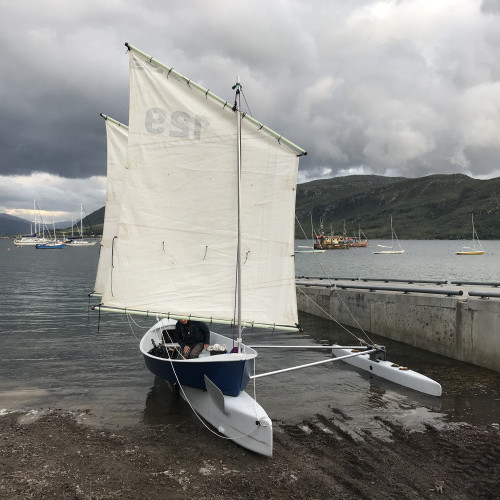
Needing a boat which I could both afford and build myself, I did some R&D using my 14' paddle and sail powered pirogue as "model". I did my first experiments with hastily lashed on outriggers and floats and I was ready. I stuck with the flat bottomed pirogue type I’ve built before but designed a really deep, narrow and heavily built 16' boat with an ama about 8' outboard. Built of 3/8" plywood, it’s overbuilt (1/4" would have sufficed), but this gave it solidity, draft and waterline length firmly in the water. With little flare, she gets good lateral resistance from her nearly flat leeward hullside, and sails to weather creditably well only rarely needing the leeboard (mostly for light air). This pirogue design is well suited to South Louisiana coastal waters, with the thin water, mud flats, oyster reefs, and sandy barrier island beaches. My next hull though, if there is a next, will be a V-hull for superior sailing characteristic without the need for underwater foils. Currently reading with great interest your articles on model testing. Actually, while not eschewing modern high-tech designs, I simply ignored most of it and turned my attention to what Micronesian natives have done because our situations were similar: we have to work with materials and techniques available to us. Their wisdom has worked for thousands of years and still works: they’re still voyaging!The Tacking RigI began with a "tacking" rig: a lateen sail from a short and stumpy freestanding mast. I was already very familiar with its characteristics from using it on my previous small boats, and I could easily build it using bamboo spars and a polytarp sail. The only photos I have of Voyager are with this rig. It performed as expected: really well on the tack with the outrigger to windward and poorly on the other tack. I had built mast steps and collars into each end so that in the event of a really long tack of many miles I could always have the float to windward but for short tacking I was disadvantaged. Sure I could utilize a hiking board for power on the “bad” tack, but I never did like seeing the ama gradually "submarine" as I sheeted in the sail on the bad tack. I just don’t like amas to leeward! Traditional Crab ClawFinally - even reluctantly, in view of its idiosyncrasys - I decided to try the Micronesian style rig with its central pivoting mast. My first few shunts with 90 square feet of sail luffing were daunting, but each time the sail was sheeted home again and I shot off like a rocket, I was 'blown away'! Lots of fine tuning was required and since I elected not to use any kind of mast crutch holding the mast from tilting to windward, I did lose the whole rig overboard to windward quite a few times before I learned not to get backwinded! (Embarrasing and an onerous task to get clear as you may imagine.) I have employed a makeshift mast crutch experimentally but I always feared a windward capsize if I were to be backwinded badly enough. You see my ama is of the heavy solid type and not very bouyant. Quarter Rudder DesignOnce I discovered an effective rudder arrangement, my backwinded days were over. If I did chance to pinch too high to windward, a quick tug at the tiller would bear me away in plenty of time to avoid the dreaded condition. (With due respect to John Dalziel, initially a steering oar fan myself, I now have no use for them.) I utilize only one shroud (3/8" dacron, I believe) and no backstays. The shroud leads out to a yoke over the ama, through a bored hole and back to a cleat inboard, thus is adjustable to control the angle of the mast athwartships. Backstays didn’t seem necessary, didn’t want the extra rigging and work. Of course, going upscale in size they’d be needed, but its manageable at this size. Only on a dead run was something needed because with no rearward pull on the sail it would lift the mast right out of its perch amidships. Of course we rarely run in a outrigger but a simple lanyard tying the mast base to its chock remedied the problem. Only in a really plunging sea, say a 2' to 3' chop my upper limit was sail control scary when shunting: as you neared the ends of the boat bringing the tack of the sail to its "new bow", if you plunged down into a trough at that moment, the momentum of the whole rig pitching forward could become great and your risked losing the rig overboard. I added bungee cords with hooks to each bow to secure the heel of the yard down into its chock, else it would bounce up and out when you crested waves. Also, in the same type of nasty chop, if during a shunt the ama dropped suddenly into a deep trough, the mast would lurch to windward in spite of the drag of the wildly flogging sail pulling to leeward. I’m thinking that both of these problems might be solved with a track for tack of the sail along the lee rail. hmm... The mast can be quite slight in scantlings (I use a 2"x2" wrapped with fiberglass and cloth) because it only carries the weight of the sail during shunting and is not functioning in compression or stress while sailing. All of the weight and thrust of the sail is taken through the yard down to the chock on the bow of the boat and by the shroud and by the sheet. I find the rig efficient, powerful and forgiving: I became quite relaxed about flying the ama for extended periods and stability seems quite good. In summary: The Micronesian rig has some wonderful traits but sail-handling at sizes much above mine becomes a marginal proposition, especially when single-handed. I would like to research and develop the tracked sail idea with a standard Oceanic lateen. DESIGN NOTE : Sailing an Open BoatI considered all sorts of flotation schemes in the beginning, for the event of capsize and/or swamping. Never effected any however, couldn't decide on one and stopped worrying about. My boat is recoverable even when "turned-turtle". It comes back upright completely swamped (no air pockets). And floating, of course (hurrah for wood). The boat should be recoverable in this condition: just bail out and go. One problem: The graceful curving sheerline I built into her keeps her gunwale amidships underwater for about 1/3 of her length! (She's heavily built.) This makes her impossible to bail out. (A series of hard shoves forward from her stern might slosh enough water out of her to get the gunwale above water: this could be effected in flatish water but unlikely in any waves). Bottom line: my next boat will have a much flatter or dead flat sheerline. Not as attractive, but it should eliminate that problem. Pass this caveat on to anyone you know considering an open boat without flotation! CommentsPost a New CommentCommenting is not available in this weblog entry. |
ResourcesKat & ProaWakataitea Tiki 46 Apacolypso Designs Siam Sailing Roxane and Romilly Tom Speer’s Shunting Foil Sections Boat Bits Lunada Design Tacking Outrigger Seventy Point Eight Percent Arpex Inigo Wijnen Slider Cat Chine Blog Amateur Boatbuilding Out Your Back Door Outrigger Sailing Canoes Sailing Anarchy Canoes of Oceania Never Sea Land A Tiki in Thailand Canoe Sailing Magazine Wikiproa K-Proa Triloboats Cheap Pages James Francis Boats Proa Web Sites Peak Energy Balogh Sail Designs Hydrovisions Cape Falcon Kayak Multi Marine L-7 Crab Claw Catamaran Mehrrumpfboote Openboat Oar Club John Welsford Small Craft Design Global Rich List Skinboat School OCPaddler.com Jubilee USA Network Zephyr Kayak Sails Chesapeake Light Craft Nigel Irens Design Tarawa, a Proa For One Polynesian Voyaging Society McGowan Marine Design RealClimate - Climate Science Small Sailboats UK |