Two if by sea. |
Journal CategoriesAll CategoriesMonthly ArchivesMay 2008April 2008 March 2008 January 2008 December 2007 May 2007 October 2006 March 2006 January 2006 November 2005 October 2005 September 2005 August 2005 July 2005 June 2005 May 2005 April 2005 March 2005 StatsTotal Entries: 171Total Comments: 223 Most Recent Entry: 05/09/2008 Most Recent Comment: 05/09/2008 |
Entries | PortfolioSamwise - Part 3The third (and hopefully final) iteration of Samwise the micro-cruising proa.
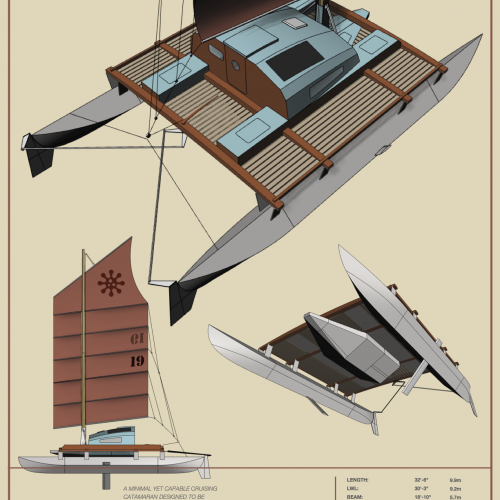
![]() Some fairly dramatic changes since Samwise Part 2 (Part 1 is here). The biggest change is that Sam is now a balls out Atlantic proa - rig placed in the windward hull. No faux Pacific, "weight to windward" sham, an Atlantic proa is Sam I am. Larger pics after the jump. Samwise - Part 2There and back again, again.
I fleshed out a few scale drawings of Samwise last week. In keeping with the minimalist theme, I'm doing the minimum of calculations. As you can see, proportions have altered a bit - but form follows function. The goal was to make the hull sides from straight ripped ply - 2' wide - easy as pie. The straight ply goal meant the crossbeams buried in the hulls had to go, so now they're lashed or bolted to the deck in beach cat style. The cabin has comfortable sitting/laying about headroom, 2' beam on the bottom. I'm debating whether I need a solid cabin or not. I could see small dodgers fore and aft, and making him into an open sailing canoe.Still no rudders, as you can see. I'm quite certain the boat will self-steer as if on rails on most courses, and it would be fun to steer the boat by sail trim alone, and no rudders would save a lot of building time and trouble, but still... rudders are nice. My enthusiasm for the lug rig has not abated. Masts are only 17' long! Read more about standing lugs in this Duckworks article by Michael Storer. ![]() LOA: 24' Length lee hull: 24' Length windward hull: 20' BOA: 12' Beam lee hull: 1'-8" Beam windward hull: 2'-8" Interior headroom: 3'-6" SA: 220 sq. ft. Rig Height: 22'-8" There and Back AgainSamwise is a minimalist cruising proa, which is really the only kind of proa there should be, IMHO. The only thing not minimal is the performance - the proa’s raison d'etre. The basic idea is reliable and cozy camp cruising in the Pacific NW - where the water is generally frigid and the air is generally tolerable.Sam’s godfathers include Matt Layden's Paradox and Rob Denney's Harry, while a host of uncles include Phil Bolger, Peter Spronk, Dick Newick and Ralph Munroe. He (all proas are masculine) features simple plywood construction, an enclosed sailing cockpit, plenty of deck space, endless conversations at the dock, and the ability to go there and back again. ![]() The crew helms from an enclosed sailing cabin - which is a nice feature in the Pacific NW and its nearly iceberg laden waters. Laugh at the freezing spray as you drive like an arrow to windward! Mock the waves as they surge impotently against your plexiglass shielding! Unlike tacking craft, proa crew have no need to make the treacherous trek to the other side with every tack. You are always on the good side of a proa. In the unlikely event of pleasant sailing weather, you can slide open the hatches, or sit atop the flat cabin top, or even sprawl out on the trampoline, catching the sun. The tramp will also make a fine place to pitch a tent for overnighting - if a real double berth is required. The leeward hull is the load bearer, so it stretches out to 24' of lean, wake-cutting form. The windward hull is the ballast, which makes do with 18' of LWL. Skilled sailors will fly the windward hull at every opportunity. Being flat-bottomed in sharpie style, the hope is that it will plane if given half the chance. The free-standing schooner rig makes for a criminally low center of effort, while the standing lugs create a powerful yet balanced, easily handled sail that requires no purchase on the sheets - which comes in handy during a shunt. The forward lug is rigged with the mast to windward (its most aerodynamically advantageous position) while the aft lug is set opposite, which moves the combined CE well forward (a desirable thing on a proa). Leeway is prevented by a central, pivoting leeboard mounted on the leeward hull, and steerage is provided by fore and aft "dagger" rudders. The hope is that in the unfortunate event of a grounding, the deep leeboard will hit first, pivoting gently out of harms way as it stops the boat, whilst leaving the delicate rudder intact. As usual with proa designs, the rudders are sketchy... at best. From model testing, I found a schooner rigged proa such as this will balance and self-steer on most courses by sail trim alone - Sam, by nature, is a virtuous course keeper. Be that as it may, a real cruising boat needs a real rudder. Suggestions are welcome. The proa's beam is retracted to trailer width via telescoping aluminum beams (as an option, Jim Shanahan has proposed an ingenious hinging mechanism). Note: This sketch is a cartoon only. No plans are available. QueeQueg 18Posted: 10/30/06 |
Portfolio
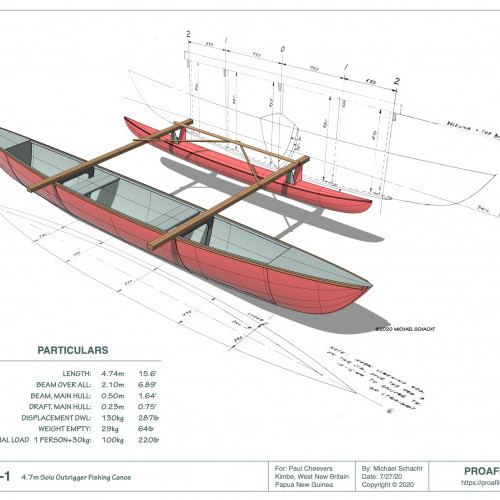
![]() Indian summer is officially over around here, and thoughts turn to winter projects in the workshop. I've worked up a little trimaran design, inspired by Solway Dory's Osprey and Chris Ostlind's XCR. It's an 18' stitch and glue plywood, 5 panel hull, with tortured ply amas and aluminum akas. Hull beam is 30". sail area: 118 sq. ft. a high aspect leeboard would be included (not shown). It would be fun to day sail, and might make a good little camp cruiser. Hawaiian Sailing Canoe RigPosted: 05/25/05 |
Portfolio
| 0 Trackbacks
A double outrigger with a windward canting rig
See, I'm anticipating the next step in sail area/performance upgrades. The Holopuni carries just 100 sq. ft. of sail, which is no doubt plenty for Hawaiian waters, and it is a safe and sane amount for a dual-purpose sail/paddle craft. But what about unsafe and insane sailing? Turbo : Hydrofoil DaysailorPosted: 03/18/05 |
Portfolio
| 0 Trackbacks
A school project from 1983 Turbo (a trendy name back in the 80's heyday of the Porsche 911 Turbo) was my project one quarter. (School of Industrial Design, University of Washington. The Dean - James Hennessey, was way ahead of the curve concerning sustainable design. He wrote a book called Nomadic Furniture in 1973 that was full of simple, light, resource/space efficient, and recycled furniture designs -- I couldn't have been LESS interested at the time... ). The project was mostly concerned with model making and presentation - and was fortunately never graded on whether the idea was actually feasible or not.
Manu Kai : Hawaiian Sailing CanoePosted: 03/08/05 |
Portfolio
| 0 Trackbacks
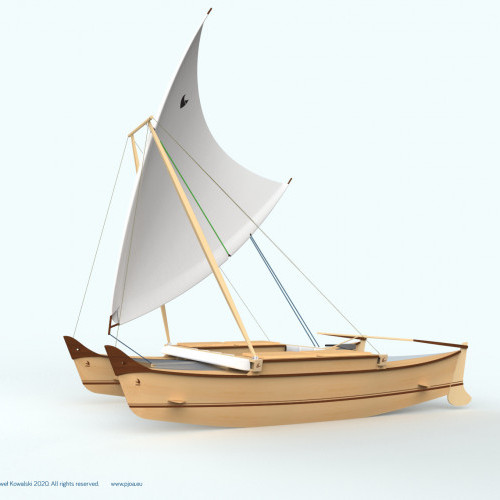
LOA: 23'Beam (sailing): 12'-0" Beam (trailer): 8'-6" Weight (approx): 750 lbs. Draft: 1'-11" SA: 205 sq. ft. Manu Kai [Bird of the Sea] is a voyaging double canoe: a sailing catamaran for raids, beach cruising, and coastal sailing. It's designed to be simple, tough, swift, safe, environmentally friendly, and economical to own and to manufacture. It is the sort of small cruiser that I wish were on the market -- that Hobie Cat® would make. Page 1 of 1 pages |
ResourcesAmateur BoatbuildingOut Your Back Door Outrigger Sailing Canoes Sailing Anarchy Canoes of Oceania Never Sea Land A Tiki in Thailand Canoe Sailing Magazine Wikiproa K-Proa Triloboats Cheap Pages - The Proa James Francis Boats Proa Web Sites Peak Energy Balogh Sail Designs Hydrovisions Cape Falcon Kayak Multi Marine L-7 Crab Claw Catamaran Mehrrumpfboote Openboat Oar Club John Welsford Small Craft Design Global Rich List |